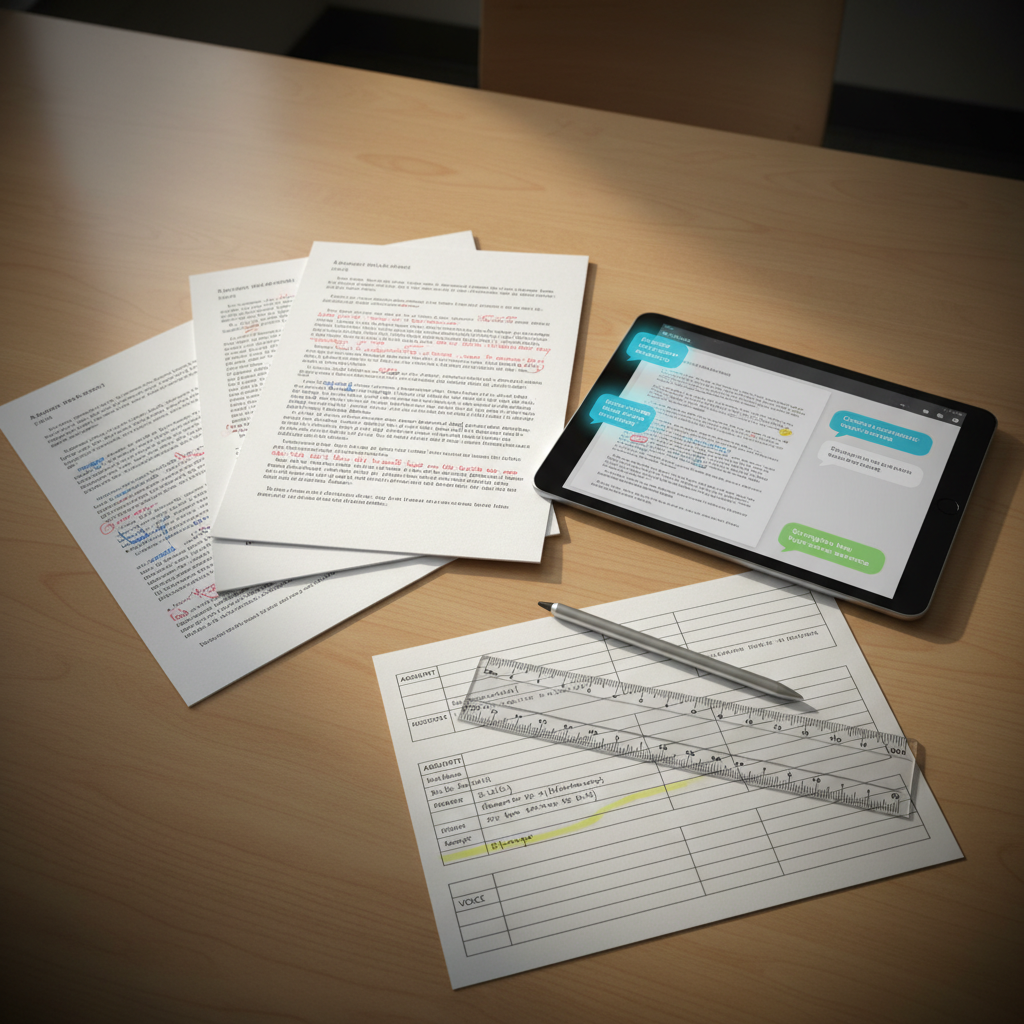
A close-up overhead view of a polished light-wood seminar table in a university office, carefully arranged with printed student essays, each page annotated with detailed handwritten feedback alongside AI-generated comment bubbles on a tablet screen. A slim, silver stylus rests between the pages, and a transparent ruler lies across a rubric highlighting criteria such as “argument”, “structure”, and “voice”. Gentle late-afternoon natural light falls diagonally across the table from an unseen window, casting soft shadows and a warm, reflective glow on the paper. Photographic realism with subtle vignetting focuses attention on the central documents. The atmosphere is reflective and analytical, emphasising ethical, high-quality feedback practices enhanced—but not replaced—by AI.

Lecturer Toolkit

AI Assistant Toolkit for Writing Lecturers is a professional learning resource that helps tertiary writing lecturers understand, evaluate, and use AI assistants in ethical and instructionally sound ways. The toolkit focuses on practical classroom application, including lesson planning, modelling, feedback, task design, and reflective teaching, while keeping student learning, critical thinking, and academic integrity at the centre.

About

Who This Toolkit Is For

This toolkit is designed primarily for tertiary writing lecturers, especially those seeking practical and responsible ways to respond to the growing presence of AI in academic writing instruction.

Our Approach

This toolkit promotes thoughtful, ethical, and context-sensitive use of AI assistants. It values lecturer expertise, student agency, critical thinking, and academic integrity.

Why It Matters

As AI tools become more common in education, writing lecturers need practical guidance to make informed instructional decisions and to adapt teaching in ways that continue to support meaningful student learning.
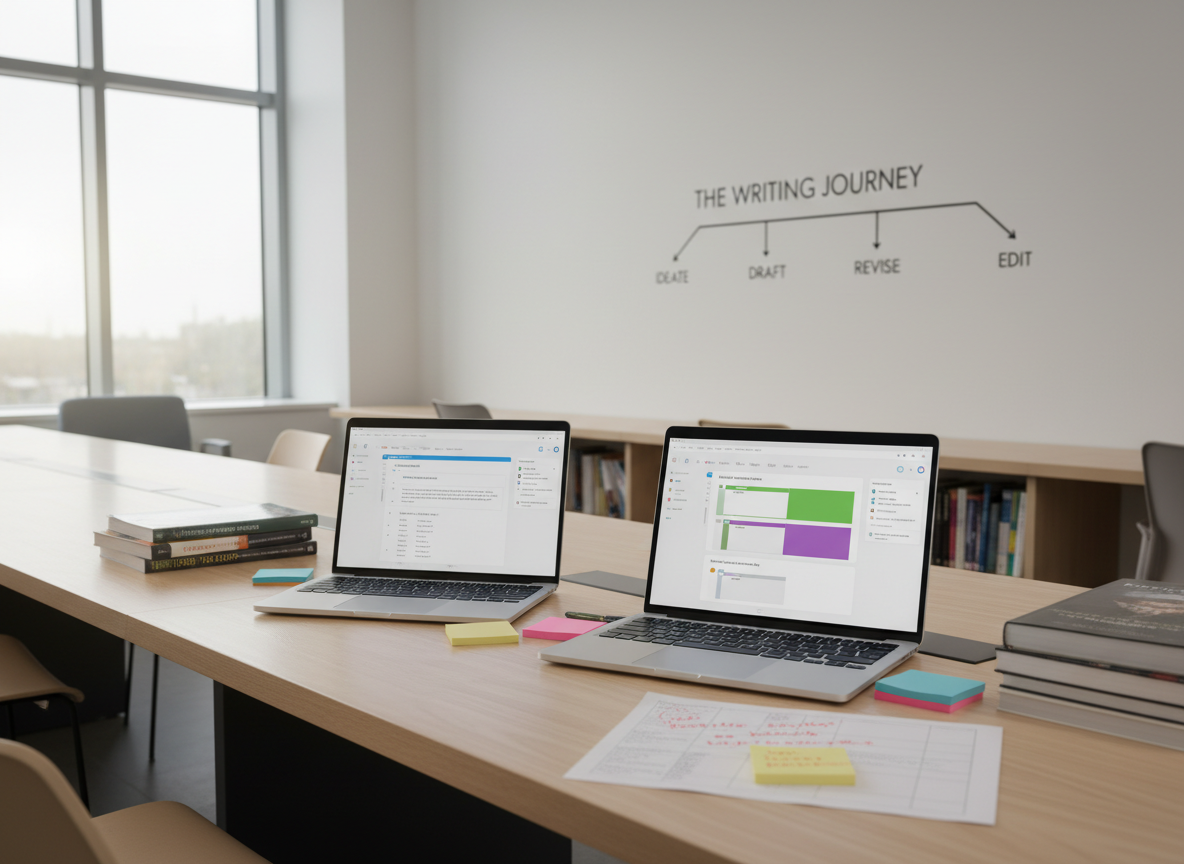

A sleek, modern university writing studio with a long, pale birch desk supporting two open laptops side by side, each displaying different structured writing outlines and AI-generated suggestions in clean interfaces. Around them are neatly stacked academic journals, colour-coded sticky notes, and a printed rubric annotated in fine red pen. Soft morning daylight enters through a large window, reflecting subtly on a matte white wall with a minimalist diagram of the writing process. Photographic realism at eye level, with a shallow depth of field that keeps the laptops in sharp focus and the background gently blurred. The lighting is calm and balanced, creating an atmosphere of professional focus and ethical, thoughtful AI-supported writing practice.
Photo by Katerina Holmes on Pexels.com

COURSE: AI

Photo by cottonbro studio on Pexels.com

CORE RESOURCES

Photo by Polina Tankilevitch on Pexels.com

SUPPORT RESOURES

Photo by Tara Winstead on Pexels.com

Blog

Reviews

A close-up overhead view of a polished light-wood seminar table in a university office, carefully arranged with printed student essays, each page annotated with detailed handwritten feedback alongside AI-generated comment bubbles on a tablet screen. A slim, silver stylus rests between the pages, and a transparent ruler lies across a rubric highlighting criteria such as “argument”, “structure”, and “voice”. Gentle late-afternoon natural light falls diagonally across the table from an unseen window, casting soft shadows and a warm, reflective glow on the paper. Photographic realism with subtle vignetting focuses attention on the central documents. The atmosphere is reflective and analytical, emphasising ethical, high-quality feedback practices enhanced—but not replaced—by AI.

Aya Nakamura

These AI-informed activities revitalised my writing tutorials and gave me language to discuss ethics with students. The scaffolded prompts saved hours of prep.

A sleek, modern university writing studio with a long, pale birch desk supporting two open laptops side by side, each displaying different structured writing outlines and AI-generated suggestions in clean interfaces. Around them are neatly stacked academic journals, colour-coded sticky notes, and a printed rubric annotated in fine red pen. Soft morning daylight enters through a large window, reflecting subtly on a matte white wall with a minimalist diagram of the writing process. Photographic realism at eye level, with a shallow depth of field that keeps the laptops in sharp focus and the background gently blurred. The lighting is calm and balanced, creating an atmosphere of professional focus and ethical, thoughtful AI-supported writing practice.

Mateo García

This toolkit turned my uncertainty about AI into structured, ethical practice. Students now question AI outputs, linking tool use to academic integrity discussions.